Construction Mesh Gardens
A sheet of construction mesh with 6” centres measures 8’x4’ and costs about $15. You can see my use of construction mesh in The First Rack
The video The Bug House Fence (My Wildlife Garden) from Smallwood Bees describes a fence/wall made from biomass enclosed between two sheets of mesh.
I wonder whether one might increase one’s growing area by building vertical walls of soil using construction mesh as the structure.
Please look again at a propped rack and consider how it might look lying on its long side, as a 4’ high fence some 8’ long. (Yes, propped racks can double as daytime chicken runs)
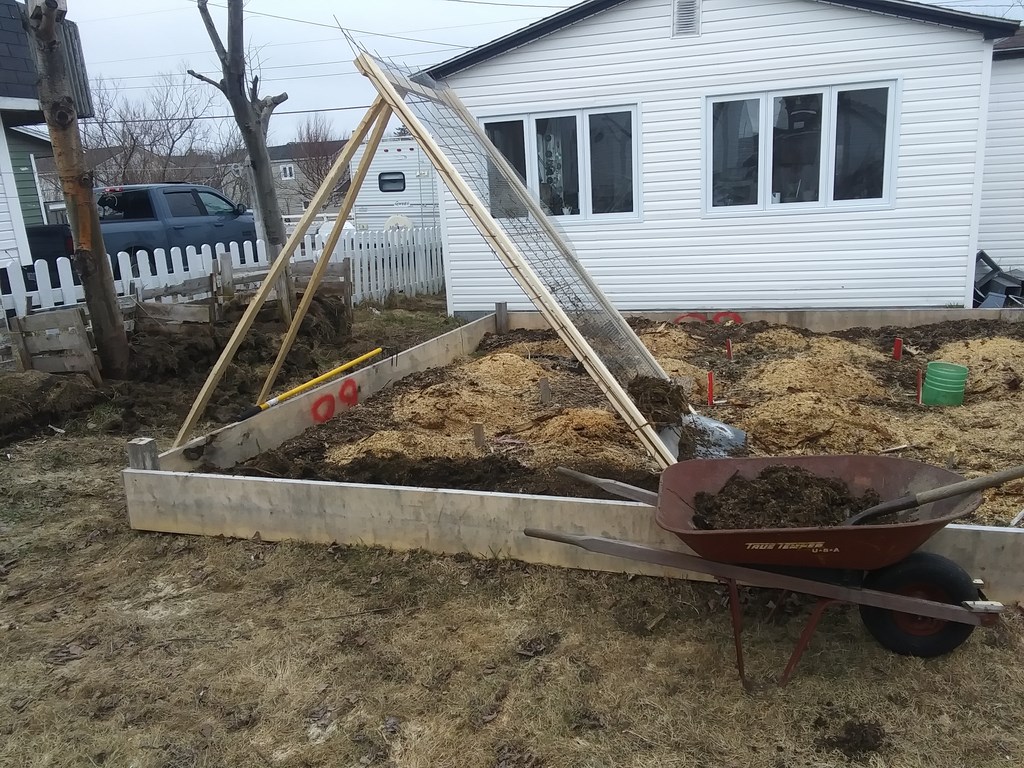
A wooden frame (can be made of stronger 2x4 timber) with 6” mesh forming a surface with 1cm or even one-quarter inch mesh as the liner.
Two such frames side by side, about 12” apart should provide a good growing range for any sort of climbing plant – peas, beans, strawberries, cucumbers, pumpkins.
The loaded soil would exert horizontal force to push the frames apart, but simple notched sticks at 12” intervals should hold the two sheets of mesh together:-
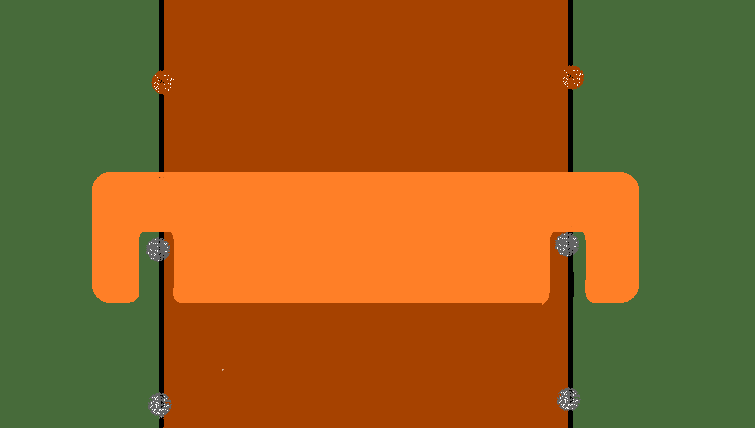
An orange piece of 1” strapping is notched; the notches sit across two of the horizontal, 8’ long rods that are spaced at six-inch intervals along the construction mesh.
Brown soil is sandwiched between the two sheets of construction mesh which is itself lined with one-quarter inch mesh.
The green garden surrounds the diagram.
So now you know that I am no artist, but imagine my raised bed populated not by a 24x16’ one-foot thick bed of rich soil, but populated by 4’ high, 16’ long sandwiches, spaced 18 or 24 inches apart, running north-south, so catching the sunlight, providing a growing area of what?
A single frame is 8’ long and 4’ high. That yields 32 square feet. But that frame has two growing surfaces, so a single frame represents 64 square feet.
I can fit two such frames north-south across my 16’ wide bed, so a single column of two frames or 128 square feet.
Suppose I arrange these columns two feet apart. That is very tight; not much room to walk between the plants and harvest peas or beans, but probably sufficient for a once-per-year harvest of pumpkins. My bed is 24’ east-west, so twelve sets of frames of 64 square feet each yields me 1,536 square feet of growing area, whereas the 24’16’ lot yields only 384 square feet.
An improvement of 4:1.
Why don’t the frames blow over? Well, diagonal braces at each end AND a frame of 2x4 that runs across the top, holding the frames together in a box structure.
Perhaps the frames can be topped up each year with compost material – sawdust and grass clippings, that will pass nutrients directly to the lower strata. Year by year I would be building vertical walls of compost and could, in the end, remove the frames and leave a rich thick bed of soil.
It will not escape your notice that by tosssing in layers of grass clippings (or dead leaves or …) a thin crust of dried grass will form across the surface of the fine mesh, providing a better container of soil particles.