709-218-7927 The Landfall Garden House 60 Canon Bayley Road Bonavista, Newfoundland CANADA A0C 1B0 |
|
|---|
.JPG)
Make More Money When Writing or Reading
Winston Churchill, Mark Twain and others, famous for their writing and speaking, are two well-known public figures who have suggested that professionals use shorter words, phrases, and sentences.
Here's why.
Suppose you are a writer and are paid by the word. Your newspaper article will be, by the editor's edict, so-many column inches, which means so-much space in the newspaper.
Suppose you are a speaker and are paid by the speech. Your speech will, by the audience's patience, be limited to so-much time in the session.
As a writer or speaker you want to convey as many of your ideas as you can in the resources available to you – space or time.
Here's an example. Suppose I am engaged to speak about Public Transit in Toronto. I have thirty minutes. I introduce myself, and spend twenty minutes describing where I grew up in The Yilgarn shire of Western Australia. All very interesting, or amusing, but that leaves only ten minutes to criticize The Toronto Transit Commission, Go-Trains, Go-Buses, streetcars, the relatively new transit card "Presto", and future plans (if any!) for improved public transit in the GTA. Better that I had not used my time in talking about The Yilgarn, right?
I am as guilty as you in using long words and phrases that consume space and time without adding to my ideas.
Rather than describe how we moved around in the Yilgarn, ("Mostly people had a car, even a beat-up old banger, and used it to drive to the local shops, to visit friends, or to do business in town. People had either a four-door sedan or a ute – the shorthand name for a utility truck, or in America a "pick-up") I'd be better off saying/writing "There was no public transit in the Yilgarn"
Rather than identifying as "I grew up in The Yilgarn shire of Western Australia" I'd be better off writing "I grew up in rural Western Australia". I'd be better off writing "I grew up in a rural area."
The same is true for the modern "What we do is we drive the automobile"; better is "We drive the automobile" and still better is "We drive the car".
Count the words in my better versions and calculate the percentage space or time saved. That will give you a first approximation to the increase in the richness of your article or speech; your broadcast will convey many more ideas per space or time with shorter words or phrases.
To calculate a much-improved percentage of space and/or time saved, and hence the number of ideas you can put across to your audience speak each chunk of text aloud ten times, each way, and use that more accurate stop-watch figure.
To get a better idea of savings, and so the value you can give to your audience speak each chunk of text aloud ten times, and use that as a better value.
Of course, shorter words mean longer navigation times through your word-processing documents, which is why you should master paragraph-processing over sentence-processing, and sentence-processing over word-processing, and word-processing over character-processing!
Try These for Size
Each word or phrase in this list is one which I have written, or have read or heard in a published article. For each item, try finding an alternative phrase with fewer syllables.
a very fast period of time
accommodate
accommodation
accumulated
almost exactly
all my
almost most of my
already begun
am into
amount of time
ask of you
at this moment in time …
at this very moment
backyard area
be able to
begin
benefaction
catenation
completely unique
concatenation
customers
deliberately designed
demonstrate
despicable
destination
detested
difficult
discrepancy
doesn’t look bad
entrapped
exact same
exact same kind of
entirely decimated.
Everyone/ev erybody
exactly equal to
exiting from
fairly unique
glacial
got this data from
gotten
high rate of speed
honestly
humanely euthanised
I can personally vouch for this
i don't believe …
i don't think …
i get the feeling that
I have ever
I have no idea
i personally
ignited into flames
in all honesty
in length
include
incredible
information
initiated
inside of
instantaneously
irregardless
is quite different
is what
its
it's
life-threatening
literally
minus three degrees below zero
Mitigate
moment in time
momentarily
most unique
much much
multi-coloured
my own
my own personal
my personal
my understanding is
nearly
no other alternative
nobody/noone
not inconsiderable
not unmanageable
off of
other alternative
out of
outside of
passed away
passed on
perhaps i should
period of time
personally, me and my team, we are …
petrified
practically
precariousness
problematic
purchase
quite unique
quantum
realize
really nice
really unique
regardless
right now
span across
specificity
still remember
sub-optimal
they claimed that they
this is what happens
this right here
unbelievable
unserious
very
very, very
very first
very unique
virtually
was going to
when i was younger ("in the past")
what i am going to do is
what it is is …
what it means is …
what they did was …
with my own eyes
witnessing
would like
you and I
you have ever
you know
your own
Note 1: The list above is provided solely as a set of exercises or discussion topics for a reduction in the number of syllables. There are words outside this loist which are candidates for better use:-
Careering across the road
Decimated the population
Accident Instead of collision in 95+% of occurrences in broadcast media or conversation.
Note 2: A general rule for seek-and-destroy is to identify words or phrases that are three or more syllables long. Reducing two syllables to one syllable gives you an advantage.
I suspect that a great deal of fanciful frills in English comes from the classical educations handed out to university students over the past three or four hundred years,
Note 3: "deliberately designed"; Sometimes a two-step dance can be performed. I count seven syllables in this two-word phrase. If I replace the phrase with "manufactured" I am down to four syllables. A replacement of that word with "made" can complete the transition.
Note 4: The languages Anglo-Saxon and Normandic-French had sex and produced an offspring language "English". One characteristic of English seems to be words that end in "tion" which, I believe, arrived (came!) with the French courts amd legal houses. In which case a general rule is that the French words Accommodation, Benefaction, Catenation, Destination and so on can easily be replaced by the shorter Anglo-Saxon words such as house, gift, joint, place. Have fun highlighting all the words that end in "tion".
Note 5: Some words strike me as useless nowadays, and yet they are in frequent use. Consider the word "understandably", four syllables.
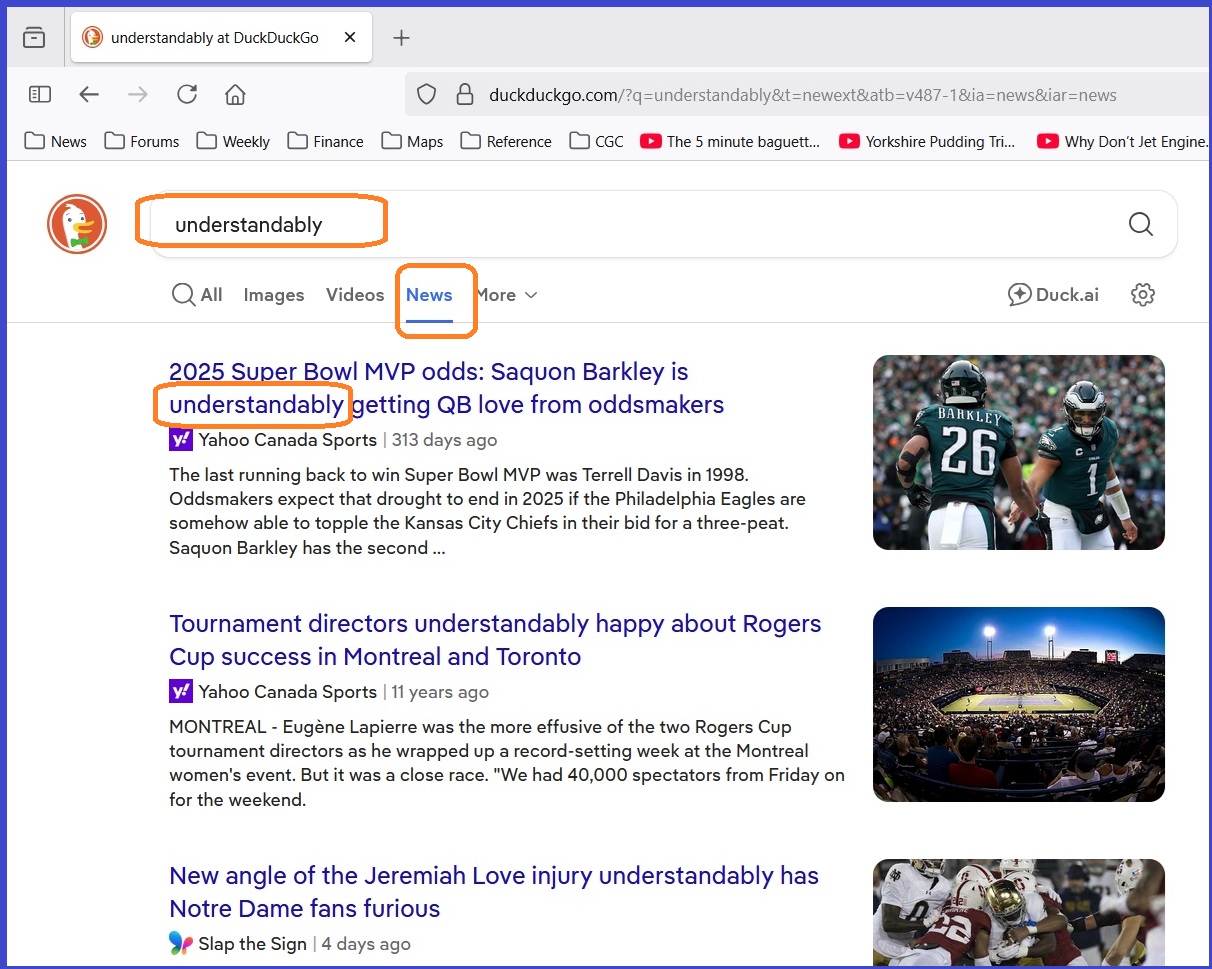
Search Google for the string "understandably"; you will be given a dictionary definition.
Just above the first result, switch from "All" to "News", and be amazed at how many headlines contain the string "understandably".
If you are bored with life, set up another Google Alert for "understandably" and let me know if you find a case where a rationaly argument can be found for use of the string "understandably". Understandably I will be upset.
709-218-7927 CPRGreaves@gmail.com Bonavista, Tuesday, May 05, 2026 9:49 AM Copyright © 1990-2026 Chris Greaves. All Rights Reserved. |
|---|