709-218-7927 The Landfall Garden House 60 Canon Bayley Road Bonavista, Newfoundland CANADA A0C 1B0 |
|
|---|
.JPG)
Another Argument Against First-Past-the-Post Voting
So last week we had a federal election in Canada. Elections in Canada are held as first-past-the-post (FPTP) on a simple majority. To be declared a winner you have to collect the highest number of votes. Thus in a voting population of 10,000 if you garner 4,000 votes, less than half the available votes, you win the election if there are three other candidates who garner 3,000, 2,000, and 1,000 votes each.
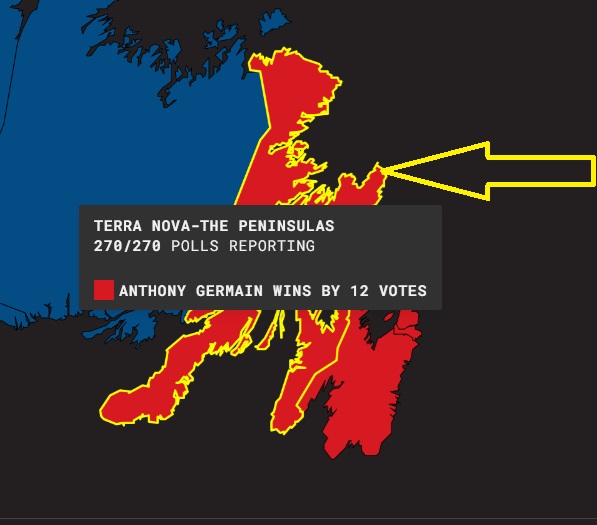
We had three candidates, and the winning candidate had 12 more votes than the closest rival.

The race was pretty much a two-party race, which is similar to any binary choice such as the Brexit Vote in 2016:=
Choice |
Votes |
% |
|---|---|---|
Leave |
17,410,742 |
51.89% |
Remain |
16,141,241 |
48.11% |
Valid votes |
33,551,983 |
99.92% |
Invalid or blank votes |
25,359 |
0.08% |
Total votes |
33,577,342 |
100.00% |
Registered voters/turnout |
46,500,001 |
72.21% |
This was a United Kingdom referendum and the result was close to a 50-50 split with a voting population of 33,577,342.
The difference in votes was 1,269,501 votes.
Consider binary or two-candidate races where the difference in votes is a mere 12 votes – where a seven-vote swing would make a difference.
Because the vote is close to 50-50, the situation is like a see-saw, a delicate balance.
Now consider a referendum where a 75% majority is required to change the course of the ship of state. What does a 12-vote difference make?
The answer is that it makes little difference. If the two parties have only 12 votes difference, that is very close to a 50-50 vote and the situation remains unchanged. A SIGNIFICANT majority should be required for major decisions.
If the issue is voting on whether to water the local bowling green for 50 minutes or 55 minutes, the issue is not significant and a FPTP system, fifty-percent plus one – will do.
But where the voting is considered to be a major decision, if FPTP voting is being used, than a seriously high majority should be employed.
709-218-7927 CPRGreaves@gmail.com Bonavista, Friday, May 08, 2026 5:24 PM Copyright © 1990-2026 Chris Greaves. All Rights Reserved. |
|---|